Fysiio

Paper can’t move.
Video can’t turn.

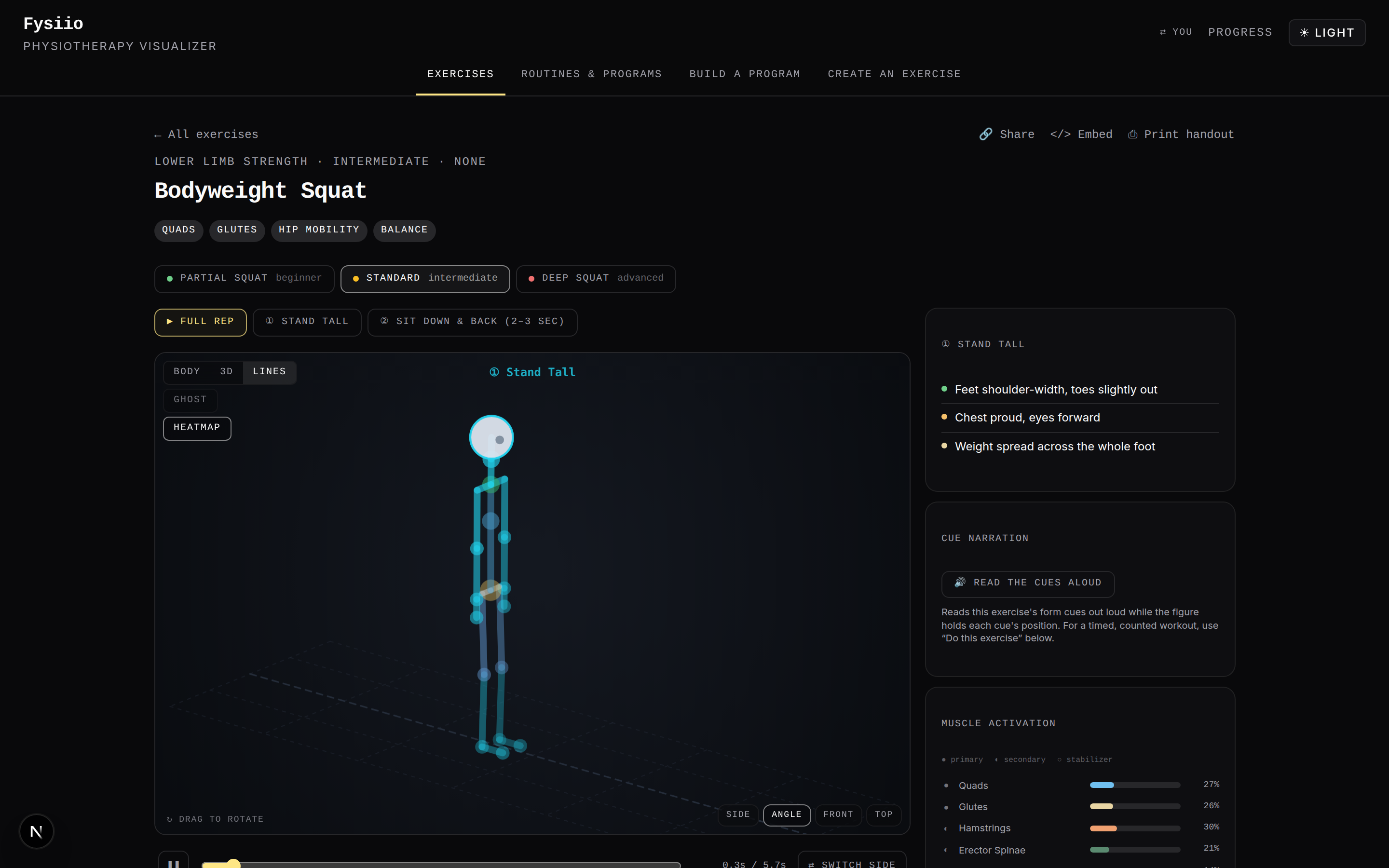
Computed movement does both jobs at once — rotate it, slow it down, change the difficulty, and still hand someone a printed sheet at the end.

See it move →

A real squat, computed live — not a filmed clip.

Three ways to hand someone an exercise.

We built the third column, so we judged it the same way we’d judge the other two — row by row, against what a patient actually needs. It doesn’t win everything.

Comparison of a paper exercise sheet, an exercise video, and the Fysiio movement engine across eight patient-facing capabilities
What a patient needs Paper sheet Exercise video Fysiio engine
See it from another angle ✗fixed illustration ✗fixed camera ✓drag-to-orbit4 camera views, any angle
Slow it down or scrub through it ✗static –partialscrubbing video is clumsy ✓scrub to any frameat any speed
Change the difficulty level ✗one version only ✗one version only ✓3 levels44 variant definitions
Go home on paper ✓that’s the mediumPaper wins ✗not printable ✓printable handoutwith a QR code back to the moving version
Show a real human body ✗a line drawing ✓an actual personVideo wins ✗an illustrated modelthree render styles, none of them photographic
Open without an app or account ✓it’s a piece of paper –dependson where it’s hosted ✓it’s a linkno login, ever
Work with no internet connection ✓always ✗usually needs a connection ✓installableworks fully offline as a PWA
Show measured muscle activation ✗shows none ✗shows none ✗estimates, not measurementsclinically authored, labeled as such
Keep patient data off a server ✓none, ever –platform-dependent ✓nonenothing leaves the device

Paper sheet

Diagrams and instructions on a printed page.

  • See it from another angle✗fixed illustration
  • Slow it down or scrub✗static
  • Change difficulty level✗one version only
  • Go home on paper✓that’s the medium Wins
  • Show a real human body✗a line drawing
  • Open without an app✓it’s paper
  • Work offline✓always
  • Measured muscle data✗shows none
  • Data off a server✓none, ever

Exercise video

A filmed clip of someone doing the move.

  • See it from another angle✗fixed camera
  • Slow it down or scrub–clumsy to scrub
  • Change difficulty level✗one version only
  • Go home on paper✗not printable
  • Show a real human body✓an actual person Wins
  • Open without an app–depends where it’s hosted
  • Work offline✗usually needs a connection
  • Measured muscle data✗shows none
  • Data off a server–platform-dependent

Fysiio engine

Movement computed live from clinical joint angles.

  • See it from another angle✓drag-to-orbit, 4 views
  • Slow it down or scrub✓any frame, any speed
  • Change difficulty level✓3 levels, 44 variants
  • Go home on paper✓handout with QR code
  • Show a real human body✗an illustrated model
  • Open without an app✓it’s a link
  • Work offline✓installable PWA
  • Measured muscle data✗estimates, labeled as such
  • Data off a server✓nothing leaves the device

Yes, we scored ourselves ✗ twice. Honest tools are easier to trust.

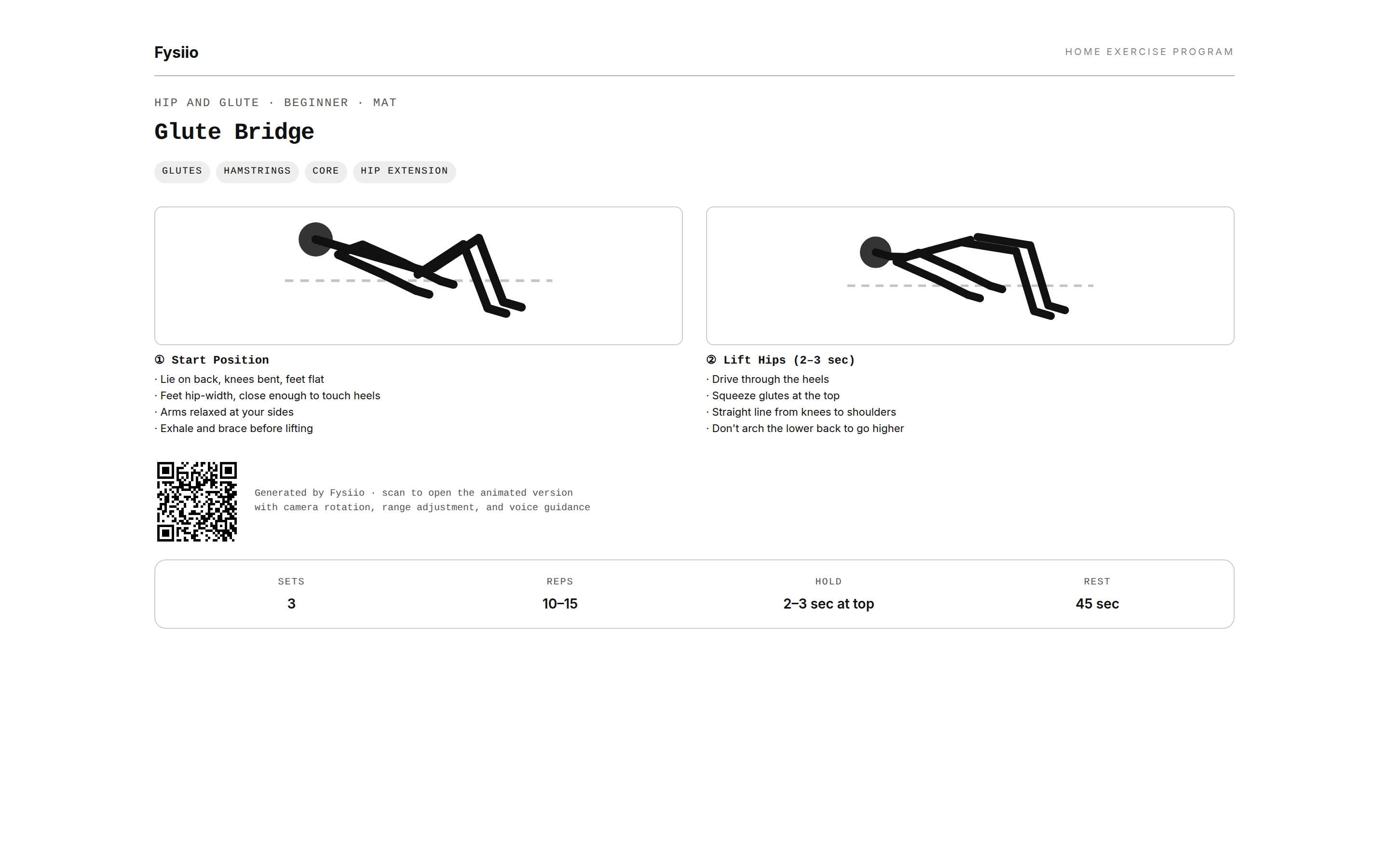
A printed Fysiio exercise handout with a QR code linking back to the moving version, shown in light theme

Keep what paper got right.

Paper doesn’t need a battery, an app, or a signal. It sits on a fridge. Nobody's ever complained that a sheet of paper was too slow to load. Those are real advantages, and we didn’t want to throw them away just because the rest of the page moves.

  • Fysiio prints too — a handout generated from the same computed movement, not a separate design.
  • Each handout carries a QR code back to the version that turns, scrubs, and adjusts difficulty.
  • Nothing about the printed sheet requires an account to make or to read.

Questions clinics actually ask

Is it medical advice?

No — it’s an educational tool. It shows a clinician-authored movement; it doesn’t diagnose, prescribe, or replace judgment made in the room.

Does the patient need an account?

No. There’s no login and no database. A program is encoded directly into the link a patient is given — open it, and it’s there.

What about the muscle data?

Clinically authored estimates, labeled as such. They’re a teaching aid for which muscles a movement targets, not a measurement of any individual patient.

See the column that does both jobs.

Browse the library the way a patient would, or look at the clinic side built for prescribing it.